Northbeam Alternative for Lead Generation: When You Need Profit, Not Just Attribution
Looking for a Northbeam alternative usually means something isn’t fitting. For ecommerce brands, the fix is often a different attribution tool. For lead generation and service businesses, the real gap is different: you need to know which campaigns made money after partner payouts, refunds, and fees, not just which ones earned the credit. This guide explains what Northbeam does well, the most common alternatives, and when you need a profit layer instead.
Key takeaways
- Northbeam is a marketing intelligence platform for ecommerce and direct-to-consumer brands, combining multi-touch attribution, media mix modeling, and incrementality testing.
- The right Northbeam alternative depends on your business model: store orders, enterprise media mixes, or deals that close in a CRM.
- For lead generation, the costs that decide profit (partner payouts, refunds, chargebacks, financing fees) arrive after the conversion.
- In our example, a campaign with a 3.0 ROAS loses $6,500 once every cost is counted.
- Allocera CDAI calculates profit per campaign every night and makes one clear decision for each. It can run alongside any attribution tool.
What Northbeam Does Well
Before choosing a Northbeam alternative, it helps to be clear about what Northbeam is good at. Northbeam calls itself “the marketing intelligence platform for profitable” growth, with a full suite of measurement: multi-touch attribution, incrementality, and media mix modeling.
- Multi-touch attribution shows which touchpoints across channels contributed to each conversion.
- Media mix modeling estimates how each channel contributes over time, including channels that are hard to track click by click.
- Incrementality testing. Northbeam says its incrementality product automates lift testing and unifies the results with its attribution and mix modeling. AdExchanger reported in April 2026 that it launched with Meta and Google as test platforms.
Independent reviews, such as SalesHive’s Northbeam review, describe it as built for ecommerce and direct-to-consumer brands. If that is your business, Northbeam is a serious measurement platform, and you may only need a Northbeam alternative for reasons like budget or team fit.
Signs You Need a Northbeam Alternative (or a Different Kind of Tool)
Most searches for a Northbeam alternative fall into two groups. Ecommerce brands usually want similar attribution at a different price or with a different interface. Lead generation and service businesses usually have a different problem entirely. You are in the second group if these sound familiar:
- Your sale closes in a CRM, not a checkout. A signed case, a booked job, or a new resident is recorded in HubSpot or Salesforce, often weeks after the lead.
- You buy leads or pay partners. Lead vendors and partners take a payout on every lead or deal, and it varies by partner.
- Money comes back later. Refunds, cancellations, and chargebacks arrive long after the original conversion.
- You need a decision, not another dashboard. Your team wants to know what to do with each campaign tomorrow, not interpret a new set of charts.
If that is you, switching from one attribution tool to another won’t close the gap. The Northbeam alternative you need is a profit view that sits on top of the tools you already use.
Northbeam vs Allocera at a Glance
Allocera isn’t a copy of Northbeam, and it isn’t trying to be. As a Northbeam alternative for lead generation, it answers a different question. Here is the comparison in one view.
| Northbeam | Allocera CDAI | |
|---|---|---|
| Main question | Which channels and touchpoints drive conversions, and what is incremental? | Did each campaign make money after every cost, and what should I do? |
| Built for | Ecommerce and direct-to-consumer brands | Businesses running paid ads or buying leads, with HubSpot or Salesforce |
| Where revenue comes from | Tracked conversions and orders | Closed deals in your CRM |
| Core methods | Multi-touch attribution, media mix modeling, incrementality testing | Contribution margin per campaign, eight nightly decisions |
| Main output | Measurement of channel impact | One decision per campaign, every night, with the numbers behind it |
Northbeam’s description comes from its own website and blog, linked above. Features change, so check current plans with the vendor.
Common Northbeam Alternatives by Use Case
Roundups of Northbeam alternatives, such as this list from Research.com, mostly feature other ecommerce attribution and analytics tools. The names that come up most often, and what each is usually chosen for:
If you run an online store and just want a different attribution tool, compare the first three directly with their vendors. If your revenue closes in a CRM and profit is your blind spot, read on.
What to Look for in a Northbeam Alternative for Lead Generation
If you sell through leads, judge any Northbeam alternative against the way your money actually moves. These six questions separate tools that fit lead generation from tools built for store checkouts.
1. Does it read revenue from your CRM?
Your real revenue is the signed case, the booked job, or the move-in recorded in HubSpot or Salesforce. A tool that only sees a conversion pixel or an ad platform’s reported value is measuring a proxy, not the money you kept.
2. Can it wait for deals to close?
Lead generation sales cycles run days to months. A tool that judges a campaign after a week will cut campaigns whose deals simply haven’t closed yet. Look for a rolling window you can match to your sales cycle.
3. Does it count partner payouts per campaign?
If you buy leads, the partner payout can be the largest cost after ad spend. It has to be tied to the campaign and the partner that produced each lead, not spread evenly across the month.
4. Does it tie refunds and chargebacks back to the original campaign?
Money that comes back weeks later should reduce the profit of the campaign that produced the sale, not whichever month it lands in. Otherwise your worst campaigns look fine and your best look worse.
5. Does it tell you what to do?
Measurement is only useful if someone acts on it. Ask whether the tool gives a clear recommendation for each campaign, with the numbers behind it, or leaves your team to interpret charts. ROAS alone is not a decision.
6. Does it refuse to act on bad data?
Broken tracking and stale feeds happen. A good Northbeam alternative for lead generation should flag missing or suspicious data and hold its recommendations until the data is fixed, instead of confidently telling you to scale a campaign on numbers that are wrong.
Northbeam Alternative Example: Credit vs Profit
Here is an illustrative lead generation campaign that shows why a Northbeam alternative for lead generation has to measure profit, not just credit. The attribution view credits it with $150,000 in closed revenue on $50,000 of ad spend, a 3.0 ROAS. The credit is accurate. Now follow the money:
| Line | Amount |
|---|---|
| Closed revenue credited to the campaign | $150,000 |
| Refunds and chargebacks | −$15,000 |
| Revenue actually kept | $135,000 |
| Cost to deliver the work (50% of revenue kept) | −$67,500 |
| Ad spend | −$50,000 |
| Lead partner payouts | −$20,000 |
| Financing, payment, and compliance fees | −$4,000 |
| Contribution margin | −$6,500 (−4.8%) |
On an attribution dashboard, a 3.0 ROAS looks healthy. After every cost, this campaign loses $6,500 a month. Scaling it would make the loss bigger. The fix might be renegotiating the partner payout or cutting spend, and neither decision is visible from attribution credit alone. For more on the costs that hide here, see how chargebacks inflate true marketing cost, how financing fees eat home services margin, and TCPA compliance costs for law firms buying leads.
The math behind this is contribution margin: revenue you actually kept, minus every variable cost of winning it. The Corporate Finance Institute calls the marketing version contribution margin after marketing. Our guide to net marketing contribution and why ROAS can look good while campaigns lose money go deeper.
Where Allocera CDAI Fits as a Northbeam Alternative
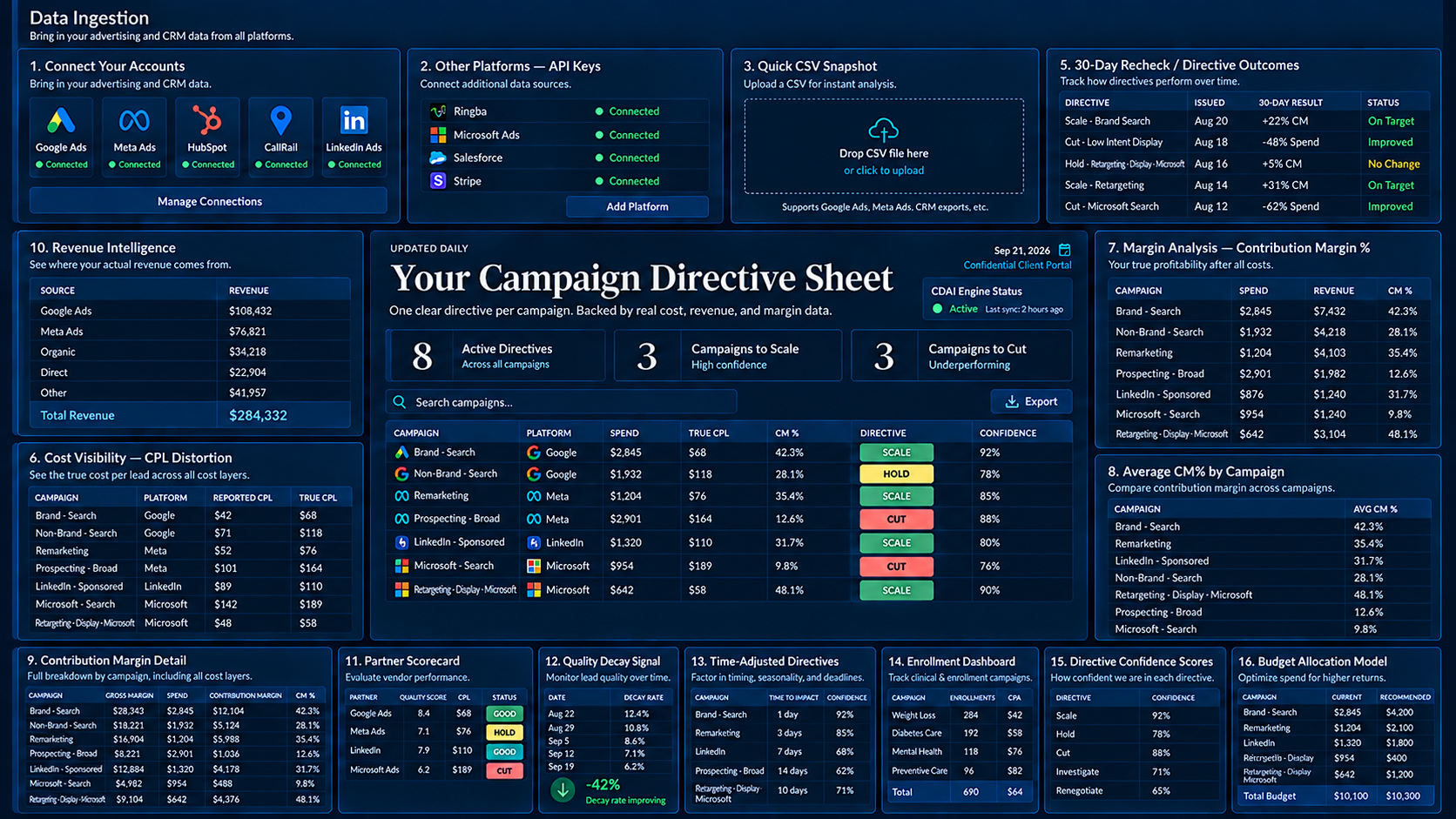
CDAI (Capital, Decision, Accuracy, Intelligence) is the engine behind Allocera Intelligence. It isn’t an attribution tool. It works alongside your CRM, your ad accounts, and any attribution tool you already use, and it answers the profit question for every campaign, every night. For lead generation and service businesses, that makes it a different kind of Northbeam alternative: the profit layer, not another attribution model.
It connects to your existing stack. Meta, Google Ads, LinkedIn, HubSpot, and Salesforce connect in one click. CallRail connects with an API key. There are also built integrations for Ringba, Boberdoo, Bing, and Stripe, plus CSV import and a webhook for any other system. You can start with one CRM and one ad account; see how it works.
Then, every night, for every campaign, it:
- Calculates real profit. True cost per lead, true customer acquisition cost, and real margin after every fee, partner payout, refund, chargeback, operating cost, and compliance cost.
- Makes one of eight decisions: scale, hold, cut, pause, quarantine, renegotiate, investigate, or flag, with the numbers and a confidence level behind it. You stay in control of every move. Our guide to marketing budget allocation explains each one.
- Judges each campaign on the right timeline. It uses a rolling window matched to your sales cycle (30 days by default), and it never cuts a campaign just because deals haven’t closed yet.
- Holds partners accountable. Close rate, payouts, refunds, and chargebacks for every lead partner, each with a risk tier.
- Stops on bad data. Serious data problems stop that night’s calls instead of driving them, and referral or offline revenue is counted but never forced into a campaign.
Validated before release
Before release, CDAI’s decisions were checked in a controlled validation across 9 businesses in 7 industries: 89.5% accurate overall (1,210 of 1,352 scored decisions), with the underlying math matching 100%. Every decision type:
| Decision | What it tells you | Accuracy |
|---|---|---|
| Scale | Spend more here | 98.0% (818 of 835) |
| Hold | Keep this steady | 95.2% (40 of 42) |
| Pause | Stop this now | 85.2% (144 of 169) |
| Flag | A person should look at this | 70.9% (200 of 282)The other 82 were neutral; none were wrong. |
| Cut | Reduce spend | 55.6% (5 of 9)All misses came from one deliberately extreme stress-test business. |
| Investigate | Something needs a closer look | 100% (2 of 2) |
| Renegotiate | A partner is taking too much | 100% (1 of 1) |
| Quarantine | Suspicious data, kept out of decisions | Caught correctly in all 12 cases. The outcome depends on a person acting on it, so these 12 count as misses in the overall number. |
Read the full method and results in our contribution margin marketing validation report.
How to Choose the Right Northbeam Alternative
Start with where your revenue is recorded and which mistake costs you the most.
Industry guides show what the profit question looks like in practice: personal injury law, HVAC and plumbing, senior living, and bought leads from Angi and HomeAdvisor.
Northbeam Alternative FAQs
What is the best Northbeam alternative?
What does Northbeam do?
Is Northbeam good for lead generation?
Does Northbeam offer incrementality testing?
Is Allocera a replacement for Northbeam?
What is incrementality testing?
What is contribution margin in marketing?
Why can a campaign with a good ROAS lose money?
Find Out Which Campaigns Actually Make You Money
Looking for a Northbeam alternative because the numbers don’t match your bank account? Keep the tools you like and add the profit layer. CDAI connects to the CRM and ad accounts you already use and tells you, every night, whether each campaign made money and what to do next.