The Margin Gap · Tool Comparisons
Triple Whale vs Rockerbox vs Allocera: Which Tool Answers Your Question?
Comparing Triple Whale vs Rockerbox usually starts with features. A better place to start is the question you need answered. Triple Whale helps ecommerce brands see what is driving growth in their store. Rockerbox helps larger brands measure which channels drive conversions. Allocera’s CDAI engine answers a third question most businesses can’t: did each campaign make money after every cost, and what should you do about it?
Key takeaways
- Triple Whale is built for ecommerce brands: attribution plus profit tracking with cost of goods, shipping, and custom expenses.
- Rockerbox is built for enterprise brands: multi-touch attribution, marketing mix modeling, and incrementality testing in one place. It is now part of DoubleVerify.
- Allocera CDAI is built for businesses whose sales close in HubSpot or Salesforce: real profit per campaign and one clear decision for each campaign every night.
- Attribution shows which touchpoints get credit. It doesn’t show whether the campaign made money after refunds, partner payouts, and fees.
- These tools can run side by side. The right choice depends on where your revenue is recorded and which question costs you the most.
Triple Whale vs Rockerbox at a Glance
Triple Whale and Rockerbox both help marketers understand which spending works, but they were built for different companies and different questions. Here is the Triple Whale vs Rockerbox comparison in one view, with Allocera alongside so you can see where each tool fits.
| Triple Whale | Rockerbox | Allocera CDAI | |
|---|---|---|---|
| Main question | What is driving growth in my store? | Which channels and touchpoints drive conversions? | Did this campaign make money after every cost, and what should I do? |
| Built for | Ecommerce brands | Enterprise brands with complex media mixes | Businesses running paid ads or buying leads, with HubSpot or Salesforce |
| Where revenue comes from | Store orders | Tracked conversions across channels | Closed deals in your CRM |
| Core methods | Attribution, profit tracking (COGS, shipping, custom expenses), AI analysis | Multi-touch attribution, marketing mix modeling, incrementality testing | Contribution margin per campaign, eight nightly decisions |
| Main output | Dashboards and insights | Measurement of channel impact | One decision per campaign, every night, with the numbers behind it |
Tool descriptions come from each company’s own website and help center, linked below. Features change, so check each vendor’s current plans before you buy.
Triple Whale vs Rockerbox: 5 Key Differences
Most Triple Whale vs Rockerbox comparisons list features side by side. These five differences matter more when you are deciding what to buy.
1. Who each tool is built for
Triple Whale is built for ecommerce brands. Rockerbox markets its attribution software to enterprise brands with complex media plans. In a Triple Whale vs Rockerbox choice, company size and business model usually decide it before any feature does.
2. Where the revenue data comes from
Triple Whale starts from store orders. Rockerbox starts from tracked conversions across many channels, including ones that are hard to follow click by click. Lead generation and service businesses usually record revenue differently, as a deal that closes in a CRM weeks after the lead, so check how any tool handles that before you buy.
3. How each measures what worked
Triple Whale combines attribution with AI analysis of the store’s data. Rockerbox combines three methods: multi-touch attribution, marketing mix modeling, and incrementality testing. If you need all three measurement methods in one place, that is the clearest Triple Whale vs Rockerbox dividing line.
4. How each handles costs and profit
Triple Whale lets brands add shipping, cost of goods, and custom expenses to track profitability. Rockerbox positions itself around measuring channel impact. For businesses whose biggest costs are lead partner payouts, refunds, chargebacks, and financing fees tied to individual deals, the profit question needs those costs matched to the campaign that produced each sale.
5. What you get at the end
Triple Whale gives you dashboards and insights about your store. Rockerbox gives you measurement of what each channel contributed. CDAI was built for a narrower job: one clear decision per campaign each night, based on profit after every cost.
What Triple Whale Does Well
Triple Whale describes itself as “the AI operating system built for modern commerce.” It brings a brand’s store, ad accounts, and other tools into one view so the team can see what is driving growth.
Three strengths stand out for ecommerce brands:
- One view of the store. Sales, ad spend, and customer data from the storefront and ad platforms sit in the same place.
- Profit tracking. Triple Whale’s help center walks brands through adding shipping, cost of goods, and custom expenses so they can track profitability, not just revenue.
- Built around store orders. For a brand whose revenue is an online order, the data model fits naturally.
In the Triple Whale vs Rockerbox matchup, if you run an online store and want one place to see growth and profit, Triple Whale is designed for exactly that.
What Rockerbox Does Well
Rockerbox says it “unifies attribution, MMM, and incrementality testing to drive smarter decisions.” That combination matters because each method answers a different part of the measurement puzzle:
- Multi-touch attribution looks at individual customer journeys. Rockerbox says its attribution software for enterprise brands builds a custom model from your own data.
- Marketing mix modeling (MMM) looks at the big picture, estimating how each channel contributes over time, including channels that are hard to track click by click.
- Incrementality testing checks whether a channel caused sales that would not have happened anyway.
In February 2025, DoubleVerify announced it would acquire Rockerbox, adding outcome measurement and attribution to its suite. For large brands with complex, multi-channel media plans, Rockerbox is built for that scale, and that is its home ground in any Triple Whale vs Rockerbox comparison.
The Question Neither Tool Was Built to Answer
In a Triple Whale vs Rockerbox decision, both tools are strongest at one question: what caused the sale? Triple Whale also tracks store profit. That’s valuable. But for many businesses, the more expensive question comes after the sale:
Did this campaign actually make money once every cost was counted?
That question gets hard when your business looks like this:
- The sale closes in a CRM, not a checkout. A law firm signs a case, a contractor books a job, a senior living community welcomes a new resident. The revenue lands in HubSpot or Salesforce, often weeks after the lead.
- You buy leads. Lead vendors and partners take a payout on every lead or deal, and it varies by partner.
- Money comes back later. Refunds, cancellations, and chargebacks arrive long after the original sale.
- Fees sit between you and the revenue. Financing fees, payment fees, and compliance costs change the math on every deal.
Attribution can tell you a campaign earned the credit for a sale. It can’t tell you that the same sale lost money after a partner payout and a refund. That is the gap between credit and profit, and it’s where most budget mistakes happen. Our guide to net marketing contribution explains the math, and why ROAS can look good while campaigns lose money shows how often it goes wrong.
Where Allocera CDAI Fits
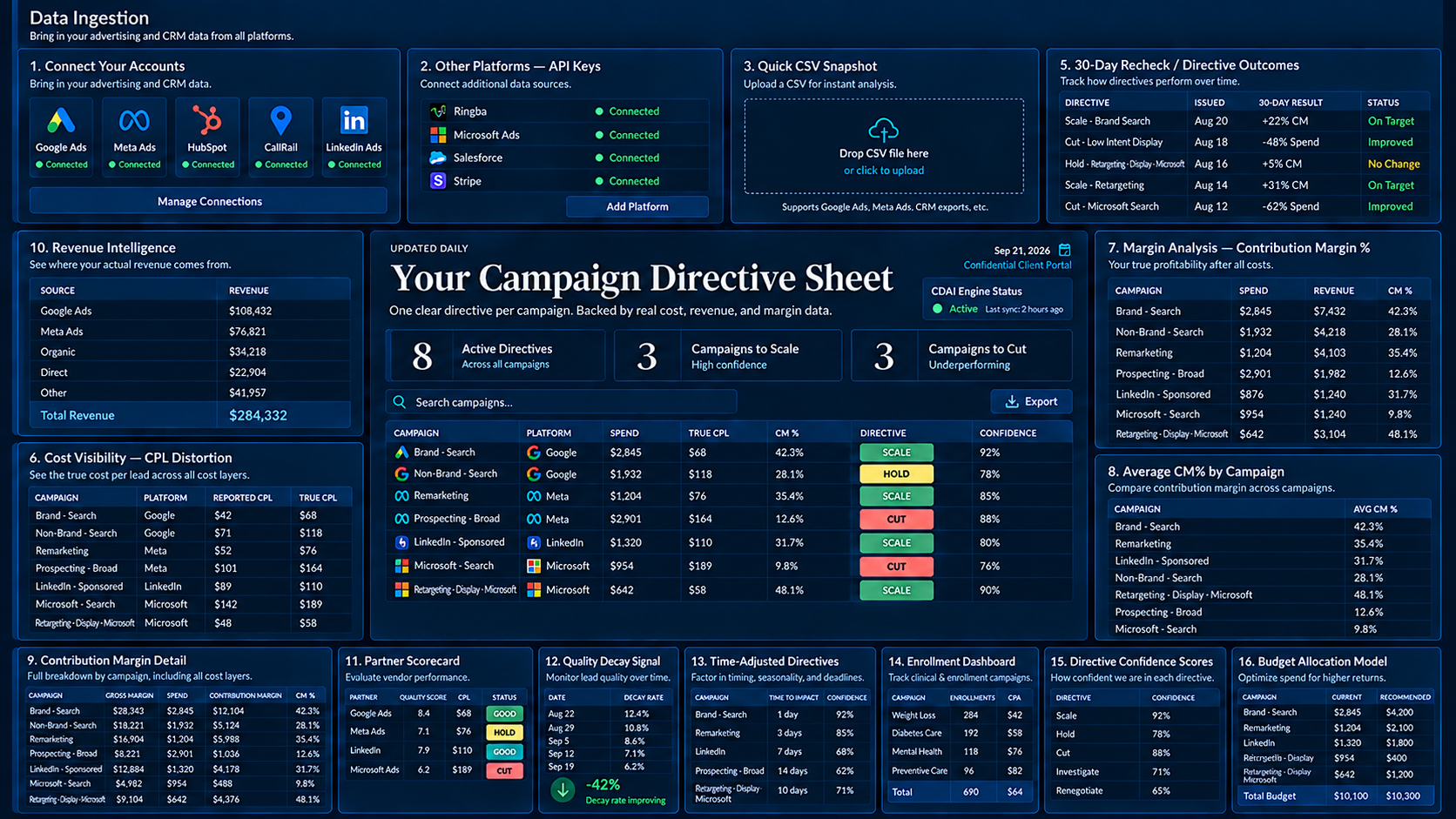
CDAI (Capital, Decision, Accuracy, Intelligence) is the engine behind Allocera Intelligence. It isn’t an attribution tool, and it doesn’t try to win the Triple Whale vs Rockerbox argument or replace either one. It works alongside your CRM, your ad accounts, and any attribution tool you already use, and answers the profit question for every campaign, every night.
It connects to your existing stack. Meta, Google Ads, LinkedIn, HubSpot, and Salesforce connect in one click. CallRail connects with an API key. There are also built integrations for Ringba, Boberdoo, Bing, and Stripe, plus CSV import and a webhook for any other system. You can start with one CRM and one ad account; see how it works.
Then, every night, for every campaign, it:
- Calculates real profit. True cost per lead, true customer acquisition cost, and real margin after every fee, partner payout, refund, chargeback, operating cost, and compliance cost. The result is contribution margin per campaign.
- Makes one of eight decisions: scale, hold, cut, pause, quarantine, renegotiate, investigate, or flag, with the numbers and a confidence level behind it. You stay in control of every move. Our guide to marketing budget allocation explains each one.
- Judges each campaign on the right timeline. It uses a rolling window matched to your sales cycle (30 days by default), and it never cuts a campaign just because deals haven’t closed yet.
- Holds partners accountable. Close rate, payouts, refunds, and chargebacks for every lead partner, each with a risk tier.
- Stops on bad data. Serious data problems stop that night’s calls instead of driving them, and referral or offline revenue is counted but never forced into a campaign.
Validated before release
Before release, CDAI’s decisions were checked in a controlled validation across 9 businesses in 7 industries: 89.5% accurate overall (1,210 of 1,352 scored decisions), with the underlying math matching 100%. Every decision type:
| Decision | What it tells you | Accuracy |
|---|---|---|
| Scale | Spend more here | 98.0% (818 of 835) |
| Hold | Keep this steady | 95.2% (40 of 42) |
| Pause | Stop this now | 85.2% (144 of 169) |
| Flag | A person should look at this | 70.9% (200 of 282)The other 82 were neutral; none were wrong. |
| Cut | Reduce spend | 55.6% (5 of 9)All misses came from one deliberately extreme stress-test business. |
| Investigate | Something needs a closer look | 100% (2 of 2) |
| Renegotiate | A partner is taking too much | 100% (1 of 1) |
| Quarantine | Suspicious data, kept out of decisions | Caught correctly in all 12 cases. The outcome depends on a person acting on it, so these 12 count as misses in the overall number. |
Read the full method and results in our contribution margin marketing validation report.
Example: Credit vs Profit on One Campaign
This is the part of the Triple Whale vs Rockerbox debate that rarely comes up. Here is an illustrative lead generation campaign. An attribution tool credits it with $80,000 in closed revenue on $20,000 of ad spend, a 4.0 ROAS. The credit is correct. Now follow the money:
| Line | Amount |
|---|---|
| Closed revenue credited to the campaign | $80,000 |
| Refunds and chargebacks | −$10,000 |
| Revenue actually kept | $70,000 |
| Cost to deliver the work (50% of revenue kept) | −$35,000 |
| Ad spend | −$20,000 |
| Lead partner payouts | −$6,000 |
| Financing fees | −$3,000 |
| Contribution margin | $6,000 (8.6%) |
The attribution report and the profit report are both right. They just answer different questions. A 4.0 ROAS looks like a campaign to scale. At an 8.6% margin, with most of the profit going to a partner payout and refunds, the better move may be to hold spend and renegotiate the partner deal. See how chargebacks inflate true marketing cost and how financing fees eat home services margin for the two costs that most often hide here.
Triple Whale vs Rockerbox for Lead Generation and Service Businesses
If you run a law firm, a home services company, a senior living community, an insurance agency, or any business that sells through leads, the Triple Whale vs Rockerbox decision looks different. Your customer doesn’t check out. They fill out a form or call, talk to your team, and sign days or weeks later.
That changes what you need from your tools:
- Revenue lives in your CRM. The number that matters is the signed case, the booked job, or the move-in, recorded in HubSpot or Salesforce.
- Leads have a price. Lead vendors and partners charge per lead or per deal, and their quality varies. A partner with cheap leads and a low close rate can cost more than one with expensive leads.
- Profit shows up late. Cancellations, refunds, and chargebacks arrive after the sale, and a campaign judged too early looks worse than it is.
Attribution tools can still help here, especially for understanding which channels start the journey. But the decision about where next month’s budget goes depends on profit per campaign after every one of these costs. Our guide to TCPA compliance costs for law firms buying leads shows one cost that attribution never sees.
How to Choose: Triple Whale vs Rockerbox vs Allocera
Start with where your revenue is recorded and which question costs you the most money when you get it wrong.
Choose Triple Whale if…
You run an ecommerce brand, your revenue is store orders, and you want one place to see growth, attribution, and profit.
Choose Rockerbox if…
You are a larger brand with a complex media mix and need attribution, mix modeling, and incrementality testing together.
Choose Allocera CDAI if…
Your sales close in HubSpot or Salesforce, you buy leads or pay partners, and you need profit per campaign with a clear decision every night.
Use more than one if…
You need both answers. Attribution tells you who gets credit; CDAI tells you whether the campaign made money. They don’t conflict.
If you’re in lead generation or services, our industry guides show what the profit question looks like in practice: personal injury law, HVAC and plumbing, senior living, and bought leads from Angi and HomeAdvisor.
Triple Whale Alternatives Worth Knowing
People comparing Triple Whale vs Rockerbox often look at other tools too. Independent comparisons of Triple Whale alternatives, such as this roundup from TrackBee, most often mention Northbeam, Polar Analytics, Hyros, Cometly, and Rockerbox. Most of them are attribution or analytics tools for ecommerce and direct-response brands.
If your revenue closes in a CRM and your biggest unknown is campaign profit rather than attribution credit, you may not need a different attribution tool at all. You may need the profit layer on top of the tools you already have.
Triple Whale vs Rockerbox FAQs
What is the difference between Triple Whale and Rockerbox?
Triple Whale is built for ecommerce brands, combining attribution with profit tracking in one view of the store. Rockerbox is built for larger brands and unifies multi-touch attribution, marketing mix modeling, and incrementality testing. The main Triple Whale vs Rockerbox difference is focus: store growth versus cross-channel measurement.
Is Triple Whale or Rockerbox better?
Neither is better in general. In a Triple Whale vs Rockerbox choice, ecommerce brands that want store growth and profit in one place usually lean toward Triple Whale, while larger brands that need attribution, mix modeling, and testing together usually lean toward Rockerbox.
Is Triple Whale only for Shopify stores?
Triple Whale is built for ecommerce brands and is most closely associated with Shopify stores. If your revenue closes in a CRM rather than an online checkout, check whether its data model fits your business before you buy.
Who owns Rockerbox?
DoubleVerify announced in February 2025 that it would acquire Rockerbox in a cash deal valued at $85 million, adding outcome measurement and attribution to its products.
What is the difference between multi-touch attribution and marketing mix modeling?
Multi-touch attribution follows individual customer journeys to assign credit to touchpoints. Marketing mix modeling uses aggregate data to estimate how each channel contributes over time. Rockerbox explains the difference between MMM and MTA in more detail.
What is the best marketing attribution tool for ecommerce?
It depends on your size and media mix. Ecommerce brands that want store growth and profit in one place often look at Triple Whale. Larger brands with complex, multi-channel plans often look at Rockerbox. Compare current features and pricing directly with each vendor before you settle Triple Whale vs Rockerbox.
Does Allocera replace Triple Whale or Rockerbox?
No. CDAI isn’t an attribution tool. It calculates profit per campaign from your ad accounts and CRM and makes one decision per campaign each night. Whichever side of Triple Whale vs Rockerbox you choose, CDAI can run alongside it; it doesn’t connect to Triple Whale or Rockerbox directly.
Which tool is best for lead generation businesses?
Lead generation and service businesses usually record revenue in a CRM, buy leads from partners, and see refunds and chargebacks weeks later. CDAI is built for exactly that: it reads closed revenue from HubSpot or Salesforce and counts every partner payout, refund, chargeback, and fee against the campaign that produced it.
Know Which Campaigns Actually Make You Money
Whatever you decide on Triple Whale vs Rockerbox, keep the attribution tools you like and add the profit layer. CDAI connects to the CRM and ad accounts you already use and tells you, every night, whether each campaign made money and what to do next.