Data-Driven Marketing Case Study: The Engine That Refuses to Guess
Data-driven marketing only works when the data is good enough to decide on. This page shows what CDAI (Capital, Decision, Accuracy, Intelligence) does when it isn’t, and how its decisions scored in the September 2026 validation: 1,352 scored decisions across 9 simulated businesses in 7 industries. CDAI has also been tested on a live pilot client and on our founder’s own past ad account history.
What this case study shows
- Bad data means no decision: stale or broken data stops that night’s decisions.
- Results by decision type: from the September 2026 validation on 9 simulated businesses across 7 industries, never one blended number.
- Math checked two ways: a 100% match, with zero mismatches.
- Tested beyond simulation: on a live pilot client and on our founder’s own past ad account history.
What Data-Driven Marketing Actually Needs
Salesforce describes data-driven marketing as an approach that “uses information from a variety of sources to gain insights into consumer behavior, preferences, and trends.” Coursera puts it more directly: it “uses customer behavior data to predict future actions.”
Both definitions assume the data is right. In practice it often isn’t: ad data goes stale, leads arrive in the CRM without the campaign that produced them, and cost data sits in systems no dashboard reads. A tool that still produces a confident number in those conditions isn’t data-driven marketing. It’s a guess with decimal places.
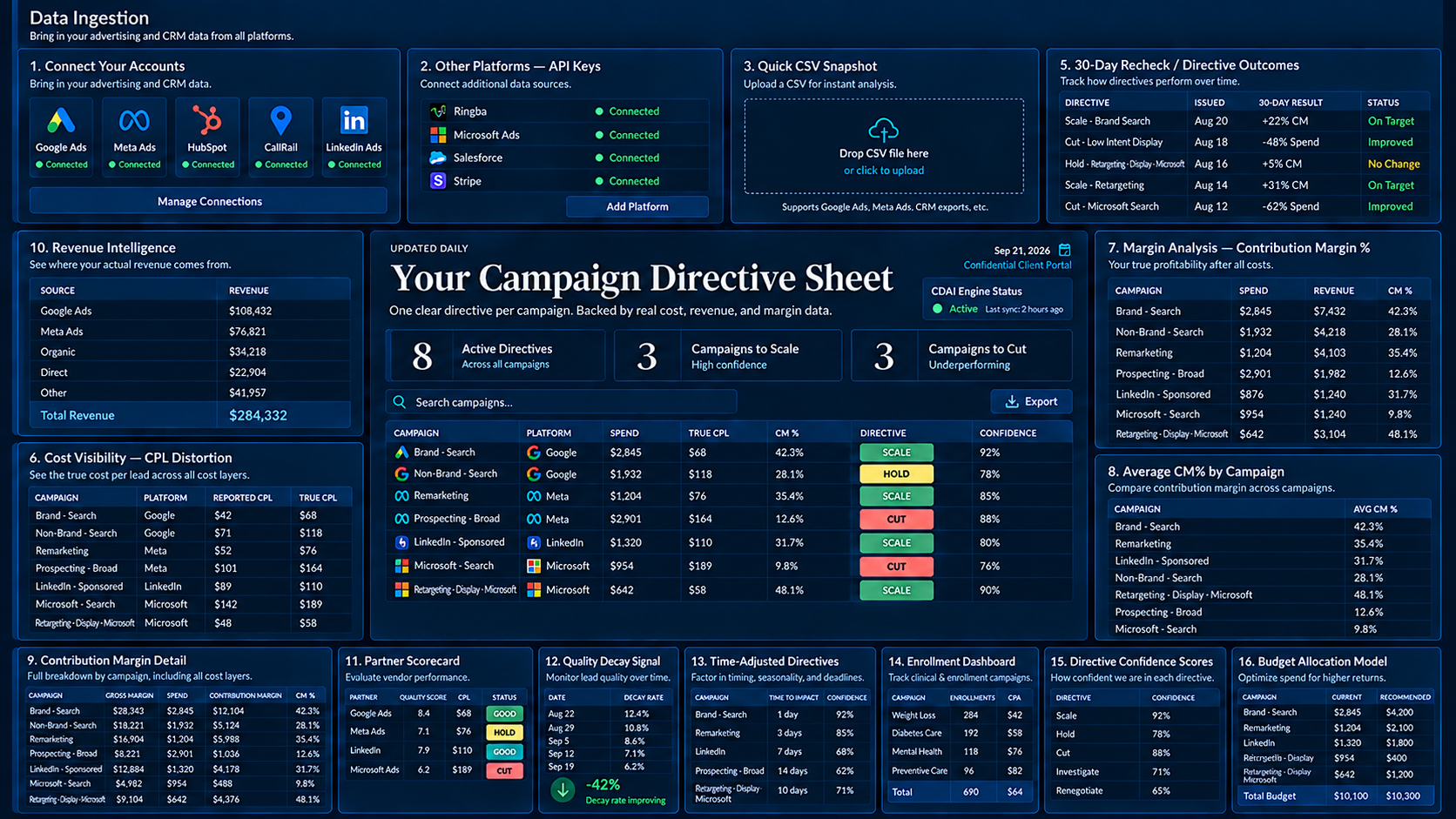
CDAI was built against that failure. Every night, before it makes a single decision, it checks whether the data is fresh, complete, and consistent. If it isn’t, no decisions go out.
What CDAI Does When the Data Isn’t Good Enough
Before CDAI makes a decision, it checks the data. These are the situations it is built to catch:
| Situation | What CDAI does |
|---|---|
| Ad or CRM data is stale | Flags the feed before it can skew a decision |
| Leads arrive with no campaign source | Keeps that revenue separate instead of forcing it into a campaign, and reports how much revenue is attributed |
| Revenue with no recorded spend, or a campaign missing from the ad platform | Flags it for a person to check |
| A serious data problem | Stops that night’s decisions instead of making them from bad data |
Why that’s the right answer: a Scale decision on stale data tells a business to spend more on conditions that may no longer exist. No decision is better than a confident wrong one. And without knowing which campaign produced each lead, there’s no honest way to calculate cost per lead by campaign, so CDAI shows the gap instead of guessing. Our guide to offline conversion tracking covers how to connect leads to campaigns.
How the Decisions Scored in the Validation
CDAI was run on 9 simulated businesses across 7 industries, so the right answer was known for every decision. Each one was graded against what actually happened to that campaign’s margin.
Beyond the simulation, CDAI has been tested on a live pilot client and on our founder’s own past ad account history. The accuracy figures below come from the simulated validation.
Accuracy by decision type, from the September 2026 validation
| Decision | Accuracy | Scored |
|---|---|---|
| Scale | 98.0% | 818 of 835 |
| Hold | 95.2% | 40 of 42 |
| Pause | 85.2% | 144 of 169 |
| Flag | 70.9% | 200 of 282 |
| Cut | 55.6%* | 5 of 9 |
| Investigate | 100% | 2 of 2 |
| Renegotiate | 100% | 1 of 1 |
* Cut: every miss came from one deliberately extreme stress-test business.
Quarantine detection was correct in 12 of 12 cases. It scores 0 of 12 because outcome scoring needs a person to act on the call. The math matched 100% when every dollar was checked two ways.
The same safeguards run every night on every connected account: CDAI rechecks its own math and stops on bad data instead of making decisions from it. When the data is good, the decisions are graded later against what actually happened. See the validation report for the full results.
The 5 Steps of Data-Driven Decision Making, the CDAI Way
- Collect. Pull spend, leads, and closed revenue from the tools you already use.
- Check. Confirm the data is fresh, complete, and consistent before trusting it.
- Calculate. Work out real profit per campaign after every cost, not just ad spend.
- Decide. Make one clear call per campaign (scale, hold, cut, or pause) with a confidence level.
- Grade. Once results are in, check whether each decision was right. Our 30-day retest explains how.
Step 2 is the step this case study is about.
How to Make Your Marketing Data Decision-Ready
- Tag every lead with its campaign. Keep campaign or UTM fields on the lead record in your CRM, not just in the ad platform.
- Connect closed revenue. Decisions need to know which leads became customers. See our guide to lead quality.
- Keep ad data current. Nightly syncs beat monthly exports.
- Add the costs outside the ad account: partner payouts, refunds, chargebacks, and compliance. Our guide to marketing costs lists them.
Data-Driven Marketing FAQs
What is data-driven marketing?
What are the 5 steps of data-driven decision making?
What is an example of data-driven marketing?
What happens when CDAI’s data isn’t good enough?
Was this run on real client data?
How accurate are CDAI’s decisions?
Decisions Only When the Data Can Back Them
Connect your ad accounts and CRM. CDAI checks your data every night and makes one clear decision per campaign only when the numbers can support it. Questions first? Send us a note and we’ll get back to you.
Request Received
We’ll review your submission and reach out within 24 hours.