The Margin Gap · Salesforce
Salesforce Campaign Influence: What It Shows, and the Profit It Misses
Salesforce Campaign Influence shows which campaigns helped create each opportunity, and the Campaign ROI Analysis report turns that into a return on investment. Both are useful. Both measure won revenue against the costs you type in, not profit. Here is how Campaign Influence and campaign ROI work in Salesforce, the four things they leave out, and how to close the gap.
Key takeaways
- Salesforce Campaign Influence links campaigns to opportunities and splits credit for the revenue between them.
- Salesforce calculates campaign ROI from the value of won opportunities and the campaign’s Actual Cost field, a single field that someone has to fill in.
- Refunds, lead vendor payouts, fees, and the cost to deliver the work usually aren’t in that math, so a campaign can show a strong ROI and still lose money.
- You can get closer inside Salesforce with discipline, or connect Salesforce to a tool that calculates profit per campaign every night.
What Is Salesforce Campaign Influence?
Salesforce Campaign Influence connects your marketing campaigns to the opportunities they helped create. On Salesforce’s Trailblazer Community, it’s described as a tool that helps you attribute a percentage of success to influential campaigns, with two versions available: Campaign Influence 1.0 and Customizable Campaign Influence.
- Campaign Influence 1.0 is the original version, used in older setups.
- Customizable Campaign Influence supports more than one attribution model, so you can decide how revenue credit is split across the campaigns that touched a deal.
The simplest model gives all the credit to one campaign, the opportunity’s Primary Campaign Source. Custom models spread the credit across several campaigns. Either way, the output is the same kind of number: how much won revenue each campaign gets credit for.
One practical warning if you switch versions: a Trailblazer Community answer notes that influence records created in Campaign Influence 1.0 won’t show up once Customizable Campaign Influence is enabled.
How Salesforce Campaign Influence Works in Practice
Salesforce Campaign Influence depends on a chain of records being filled in correctly:
- A person becomes a campaign member. A lead or contact is added to a campaign, by a form, an import, a marketing tool, or by hand.
- That person is added to an opportunity as a contact role. Auto-association, as another community answer explains, relies on campaign members being assigned as a contact role on an opportunity.
- Salesforce creates influence records linking the opportunity to the campaigns that person was a member of, and splits the credit by your model.
- When the opportunity closes, the won amount flows to the campaigns in proportion to their credit.
If a step is skipped (a lead converted without a contact role, a caller never added to a campaign), the campaign gets no credit. That’s the most common reason Salesforce Campaign Influence reports look thin: it’s usually a data-entry gap, not a Salesforce bug.
How Salesforce Calculates Campaign ROI
Salesforce includes a Campaign ROI Analysis report. Salesforce Help says it calculates the return on investment and average costs for your campaigns, with ROI calculated as the net gain divided by the campaign’s cost. In practice:
Campaign ROI = (value of won opportunities − Actual Cost) ÷ Actual Cost
The cost side comes from the campaign’s Actual Cost field. Salesforce’s own guidance is to fill out the Actual Cost field when the campaign is completed, and that value is pulled into the ROI report.
That’s a clean, simple calculation, and it pairs naturally with Salesforce Campaign Influence for the revenue side. The question is what goes into it.
4 Things Salesforce Campaign ROI Misses
None of these are flaws in Salesforce. They’re the edges of what a CRM field and a won amount can hold. But each one pushes the ROI number away from real profit.
1. Costs live in one manual field
Actual Cost is a single number. As RevOps Global puts it, it’s just a single field, and it must be manually updated by the marketing team. A Trailblazer Community answer adds that it doesn’t automatically add up custom expense fields. If nobody updates it after this month’s ad invoices, the ROI is stale.
2. A won amount isn’t money kept
An opportunity closed at $10,000 stays $10,000 in the report, even if part of it is refunded, cancelled, or charged back weeks later.
3. Costs of the sale sit outside the campaign
Lead vendor and partner payouts, card processing and financing fees, and the cost to deliver the work rarely make it into Actual Cost. They’re real costs of each sale the campaign produced. Our guide to marketing costs lists them all.
4. Credit isn’t the same as contribution
Salesforce Campaign Influence decides how to split revenue credit. It doesn’t tell you whether a campaign’s share of revenue covered that campaign’s share of costs. Two campaigns with the same influenced revenue can have very different profit.
Worked Example: Campaign ROI vs Profit
This is an illustrative example, not client data. A home services company runs one paid campaign for a quarter and tracks it in Salesforce.
| Line | Amount |
|---|---|
| Won opportunities credited to the campaign | $120,000 |
| Actual Cost entered (ad spend) | −$30,000 |
| Campaign ROI report: net gain | $90,000 (300% ROI) |
| Refunds and cancellations | −$12,000 |
| Lead vendor payouts | −$15,000 |
| Card processing and financing fees | −$3,600 |
| Cost to deliver the work | −$48,000 |
| Real profit after every cost | $11,400 |
Salesforce Campaign Influence credited this campaign correctly. The campaign is still profitable, so the decision might be the same. But the size of the win is very different, and if payouts or refunds were a little higher, the same 300% ROI would hide a loss. That’s exactly the kind of campaign our ROAS calculator is built to check.
How to Get Closer to Profit Inside Salesforce
If you want Salesforce Campaign Influence and campaign ROI to be as close to profit as possible, these habits help:
- Update Actual Cost on a schedule. Monthly at minimum, from the real ad invoices, not the budget.
- Add every cost of the sale. Include lead vendor payouts and agency fees in the campaign’s cost, or track them in custom fields and a formula that sums them (remember Actual Cost won’t add them up for you).
- Correct won amounts for refunds. Reduce the opportunity amount, or record refunds against the campaign, when money comes back.
- Enforce contact roles. No contact role, no influence. Make it part of your opportunity process.
- Pick one influence model and keep it. Changing models changes the history, so compare like with like.
- Wait for the sales cycle. Judge a campaign after its deals have had time to close; our 30-day retest explains why the window matters.
This works, but it’s manual, and it gets harder as campaigns, partners, and payment tools multiply. Our guide to calculating contribution margin shows the full method in a spreadsheet.
Salesforce Campaign Influence vs Profit per Campaign
Salesforce Campaign Influence and a profit view answer different questions, and most businesses that close deals in Salesforce can use both.
| Salesforce Campaign Influence + ROI report | Allocera CDAI | |
|---|---|---|
| Main question | Which campaigns helped create this revenue? | Which campaigns made money after every cost, and what should I do about each one? |
| Revenue used | Won opportunity amounts, split by your influence model | Revenue each campaign actually closed and kept, after refunds and chargebacks |
| Costs used | The campaign’s Actual Cost field | Ad spend, fees, partner payouts, refunds, chargebacks, compliance costs, and operating costs you add |
| How often it updates | When records and the cost field are updated | Every night |
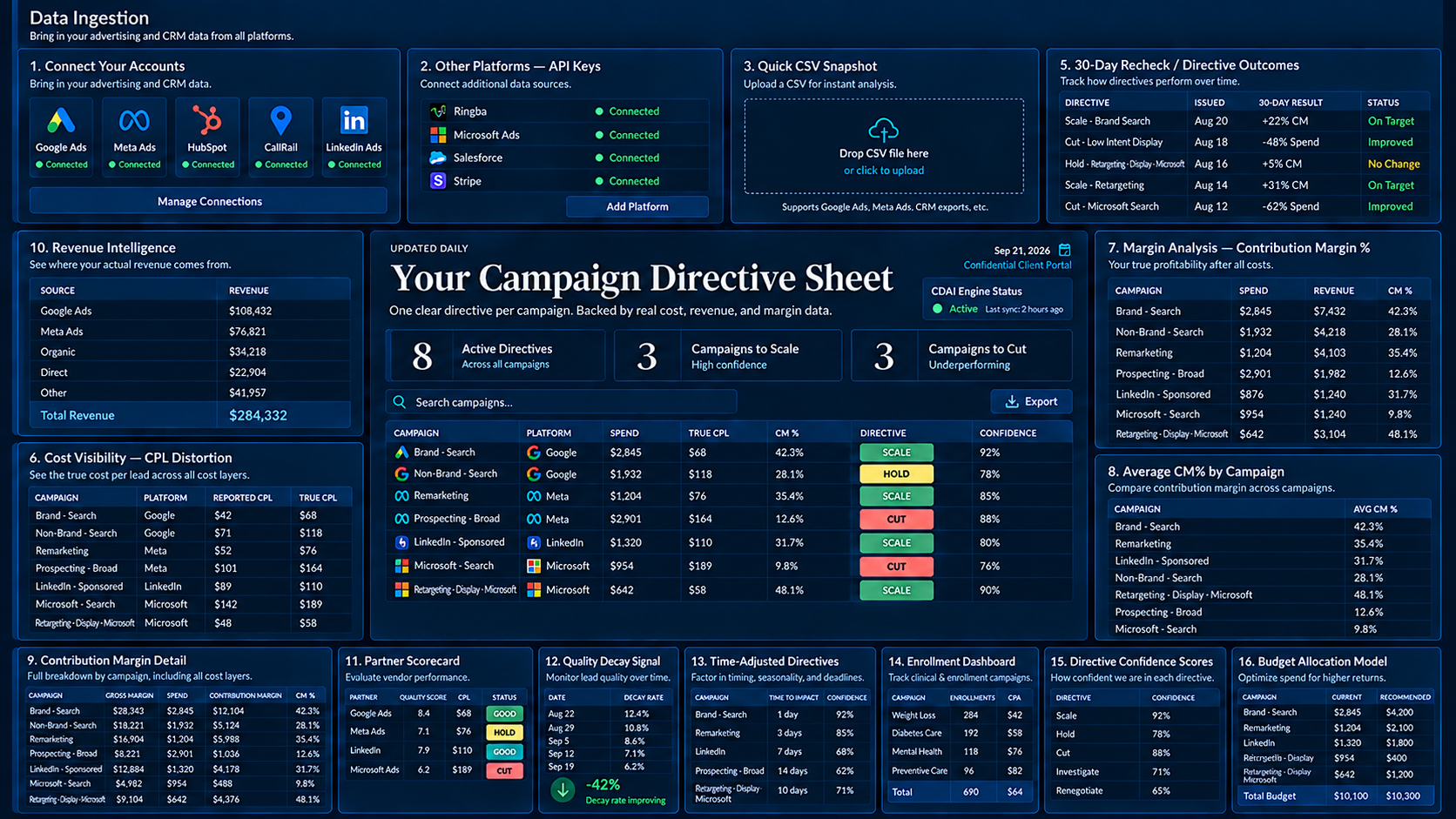
| Output | Influenced revenue and ROI per campaign | Real profit per campaign, plus one clear decision (scale, hold, cut, or pause) with the numbers behind it |
CDAI doesn’t replace Salesforce Campaign Influence or your CRM. Salesforce stays your system of record; CDAI reads from it and adds the profit view on top.
Adding Profit to Salesforce Campaign Influence
CDAI (Capital, Decision, Accuracy, Intelligence), the engine behind Allocera Intelligence, connects to Salesforce and your ad accounts. Salesforce, HubSpot, Meta, Google Ads, and LinkedIn connect in one click. Every night, for every campaign, it:
- Calculates real profit. It takes the revenue each campaign actually closed and subtracts every real cost of winning it: ad spend, fees, partner payouts, refunds, chargebacks, compliance costs, and any operating costs you add, like fulfillment.
- Makes one clear decision, with the numbers and a confidence level behind it. You stay in control of every move; nothing changes in Salesforce or your ad accounts unless a person acts on it.
- Rechecks its own math and stops on bad data instead of making decisions from it.
- Grades its past decisions once enough time has passed to judge them.
Before release, CDAI’s decisions were checked in a controlled validation across 9 businesses in 7 industries: 89.5% accurate overall (1,210 of 1,352 scored decisions), with the math matching 100% when checked two ways. Every result is in the contribution margin marketing validation report. See how it works, or read why we measure net marketing contribution instead of influenced revenue.
Salesforce Campaign Influence FAQs
What is Salesforce Campaign Influence?
Salesforce Campaign Influence is a feature that links campaigns to the opportunities they helped create and splits credit for the revenue between them. It comes in two versions: Campaign Influence 1.0 and Customizable Campaign Influence.
Why isn’t Campaign Influence showing on my opportunities?
The most common reason is a missing contact role. Auto-association relies on campaign members being added as contact roles on the opportunity. If the person who responded to the campaign isn’t a contact role, the campaign gets no influence.
How does Salesforce calculate campaign ROI?
The Campaign ROI Analysis report divides the net gain (the value of won opportunities minus the campaign’s Actual Cost) by the Actual Cost. Salesforce recommends filling in Actual Cost when the campaign is completed.
Does Salesforce include ad spend in campaign ROI automatically?
Campaign ROI uses the Actual Cost field on the campaign, which is typically entered or updated by the marketing team. If your ad spend, payouts, or fees aren’t in that field, they aren’t in the ROI.
What’s the difference between Campaign Influence 1.0 and Customizable Campaign Influence?
Customizable Campaign Influence supports multiple attribution models for splitting revenue credit, while 1.0 is the original, simpler version. Influence records from 1.0 don’t carry over when you enable the customizable version.
Is Allocera a replacement for Salesforce?
No. Salesforce stays your CRM. Allocera connects to it and to your ad accounts, calculates real profit for each campaign every night, and gives you one clear decision per campaign.
See Real Profit for Every Salesforce Campaign
Connect Salesforce and your ad accounts. CDAI calculates what each campaign really keeps after every cost and gives you one clear decision for it every night.