The Margin Gap · Free Tool
Customer Acquisition Cost Formula: How to Calculate Your True CAC
The customer acquisition cost formula is simple: what you spent to win customers, divided by how many you won. The hard part is what goes on each side. For businesses that buy leads, pay partners, or lose some sales to refunds, the basic version can understate what each customer really costs. Here is the formula, a free calculator, and how to find your true CAC.
Key takeaways
- The customer acquisition cost formula: CAC = total cost to acquire customers ÷ new customers acquired in the same period.
- Most mistakes happen in the inputs: leaving out lead payouts, agency fees and commissions, or counting customers who later cancel or refund.
- True CAC counts every acquisition cost on top and only the customers you kept on the bottom. In our example, that turns a $250 CAC into $458.
- CAC matters most next to what a customer is worth. If true CAC is higher than the profit a customer brings in, growth loses money.
The Customer Acquisition Cost Formula
The standard customer acquisition cost formula divides what you spent on sales and marketing by the number of new customers you won in the same period. Wall Street Prep describes it as dividing sales and marketing expenses by the number of new customers acquired, and Shopify’s guide puts it the same way: add up all the costs of acquiring new customers in a period, then divide by the number of new customers.
CAC = total cost to acquire customers ÷ new customers acquired
Spend $10,000 and win 40 customers, and your CAC is $250. That’s the basic version. Two questions decide whether it’s accurate:
- What’s in the top number? Just ad spend, or every cost of winning the customer?
- What’s in the bottom number? Every sale, or only the customers who stayed and paid?
We call the version that answers both honestly true CAC.
Free True CAC Calculator
This calculator runs the customer acquisition cost formula both ways. Type over the example numbers with one campaign or channel’s results for a month. Everything runs in your browser; nothing you type is saved or sent anywhere.
Compare basic CAC with true CAC
Each customer you kept really cost $458, not $250. Every acquisition cost is on top; only the 36 customers you kept are on the bottom.
Want to see whether that CAC is profitable? Our ROAS calculator shows break-even ROAS and real profit, and our contribution margin calculator shows what each campaign keeps.
What to Include in the Customer Acquisition Cost Formula
Guides differ on what belongs in the top number of the customer acquisition cost formula. Smith.ai’s guide lists advertising costs, sales and referral commissions, and outside agency fees. Software-focused guides such as SaaSHero’s talk about a “fully loaded” numerator that includes salaries and tools.
For judging one campaign or channel against another, include the costs that grow with that campaign:
| Cost | Include in campaign CAC? | Why |
|---|---|---|
| Ad spend | Yes | The obvious one |
| Agency or management fees | Yes | Split across campaigns by spend |
| Lead vendor and partner payouts | Yes | Often the biggest cost after ad spend, and never in the ad platform |
| Sales commissions per closed deal | Yes | Grows with every customer won |
| Call tracking and compliance per lead | Yes | Paid per lead or per call |
| Salaries, rent, most software | For company CAC, not campaign CAC | They don’t change when one campaign grows or shrinks |
Both are useful. Company-wide CAC, with salaries and tools, tells you what growth costs the business. Campaign CAC, with only the costs that move with the campaign, tells you where to put the next dollar. Our guide to marketing costs walks through each cost in detail.
Using the Customer Acquisition Cost Formula: 4 Steps to True CAC
- Pick one campaign and one period. Match the period to your sales cycle. If deals take two months to close, a two-week CAC will look worse than it is. Our 30-day retest explains why the window matters.
- Add up every acquisition cost. Ad spend, agency fees, lead vendor and partner payouts, commissions, and per-lead costs like call tracking.
- Count the customers you kept. Start with customers closed in the period, then subtract those who refunded or cancelled.
- Divide. Total acquisition cost ÷ customers kept = true CAC.
In the example above: ($10,000 + $1,500 + $3,000 + $2,000) ÷ (40 − 4) = $16,500 ÷ 36 = $458. The basic customer acquisition cost formula, ad spend ÷ customers closed, gives $250. Same campaign, 83% apart.
Customer Acquisition Cost vs Cost per Lead
Cost per lead is what most ad dashboards show, and it’s often confused with the customer acquisition cost formula: ad spend divided by leads. It’s useful for comparing ads, but it stops at the lead. CAC continues to the customer.
| Metric | Formula | Example |
|---|---|---|
| Cost per lead | Ad spend ÷ leads | $50 |
| Basic CAC | Ad spend ÷ customers closed | $250 |
| True CAC | All acquisition costs ÷ customers kept | $458 |
A campaign with cheap leads that rarely close can have a higher CAC than one with expensive leads that close often. For law firms, the same idea applies to signed cases; our guide to cost per signed case shows the math.
What Is a Good Customer Acquisition Cost?
The customer acquisition cost formula tells you what a customer costs; it can’t tell you whether that’s good. There’s no single good number. A good CAC is one that’s comfortably below what a customer is worth to you. The simplest test:
Maximum CAC you can afford = profit from a customer before acquisition costs
If a customer brings in $2,000 of revenue and costs $1,200 to serve (materials, labor, fees, refunds), you have $800 to spend acquiring them before you lose money. A true CAC of $458 leaves $342 of profit per customer. A true CAC of $900 loses $100 on every one.
For customers who buy more than once, use the profit over their whole relationship with you: the idea behind comparing lifetime value with CAC. Whichever you use, compare it with true CAC. Comparing a customer’s value with basic CAC makes growth look cheaper than it is.
Common Customer Acquisition Cost Formula Mistakes
- Using platform conversions as customers. A “conversion” in an ad account is often a lead, not a sale.
- Leaving out payouts and fees. Lead vendor invoices and agency fees never reach the ad platform, so they’re easy to forget.
- Counting customers who didn’t stick. Refunds and cancellations shrink the bottom number, which raises CAC.
- Mixing time periods. Spend from this month divided by customers from last month’s leads gives a number that means nothing.
- One blended CAC for everything. A blended number can hide an expensive campaign behind a cheap one. Calculate it per campaign.
Tracking True CAC for Every Campaign, Every Night
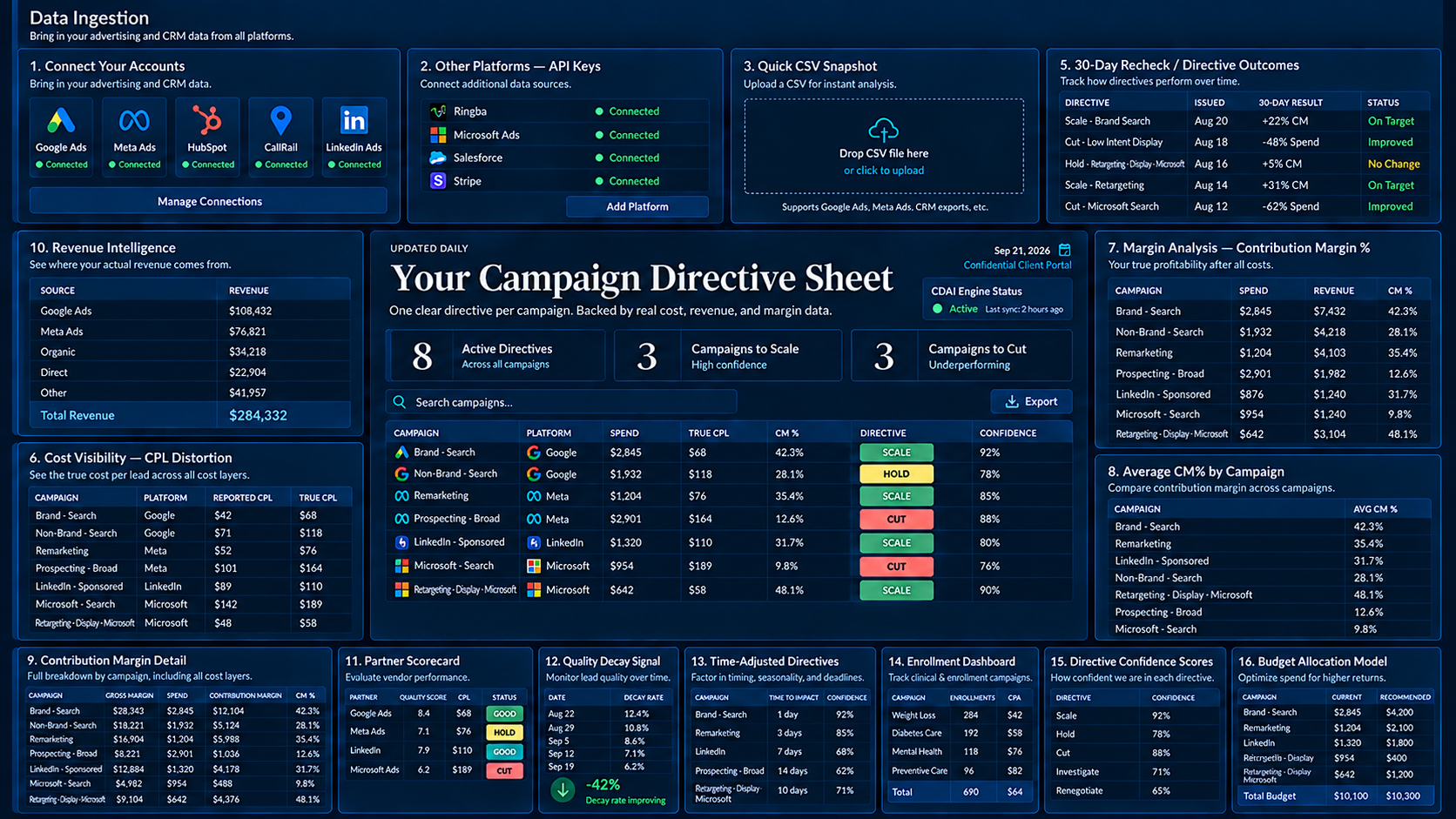
Running the customer acquisition cost formula once is a spreadsheet job. Keeping it current for every campaign, while payouts, refunds, and fees keep arriving from different systems, is the hard part. CDAI (Capital, Decision, Accuracy, Intelligence), the engine behind Allocera Intelligence, connects to the ad accounts, CRM, and other tools you already use. Meta, Google Ads, LinkedIn, HubSpot, and Salesforce connect in one click. Every night, for every campaign, it:
- Calculates real profit, including true cost per lead and true customer acquisition cost. It takes the revenue each campaign actually closed and subtracts every real cost of winning it: ad spend, fees, partner payouts, refunds, chargebacks, compliance costs, and any operating costs you add, like fulfillment.
- Makes one clear decision, such as scale, hold, cut, or pause, with the numbers and a confidence level behind it. You stay in control of every move.
- Rechecks its own math and stops on bad data instead of making decisions from it.
- Grades its past decisions once enough time has passed to judge them.
Before release, CDAI’s decisions were checked in a controlled validation across 9 businesses in 7 industries: 89.5% accurate overall (1,210 of 1,352 scored decisions), with the math matching 100% when checked two ways. Every result is in the contribution margin marketing validation report. See how it works, or read about net marketing contribution, the profit number behind every decision.
Customer Acquisition Cost FAQs
What is the customer acquisition cost formula?
CAC = total cost to acquire customers ÷ new customers acquired in the same period. For a true CAC, include every acquisition cost (ad spend, fees, payouts, commissions) and count only the customers you kept after refunds and cancellations.
How do you calculate the cost of acquiring a customer?
Pick a period, add up everything you spent to win customers in it, and divide by the number of new customers from that spend. $16,500 of acquisition costs and 36 customers kept is a true CAC of about $458.
What is a good cost per customer acquisition?
One that’s comfortably below the profit a customer brings in before acquisition costs. If a customer leaves you $800 after the cost of serving them, a true CAC of $458 is profitable and $900 is not.
What is the CLV to CAC ratio?
It compares a customer’s lifetime value with what it cost to acquire them. The higher it is, the more each customer is worth relative to their cost. Use profit, not revenue, for lifetime value, and true CAC, not basic CAC, for the comparison to mean anything.
Should salaries be included in CAC?
For company-wide CAC, yes: salaries and tools are part of what growth costs. For comparing campaigns, usually not, because they don’t change when one campaign grows or shrinks. Use company CAC for planning and campaign CAC for budget decisions.
What’s the difference between CAC and cost per lead?
Cost per lead stops at the lead: ad spend ÷ leads. CAC continues to the paying customer. A campaign can have cheap leads and an expensive CAC if few of those leads close.
See True CAC and Profit for Every Campaign
Connect the ad accounts and CRM you already use. CDAI calculates true customer acquisition cost and real profit for every campaign, and gives you one clear decision for each every night.