The Margin Gap · Methodology
Marketing Measurement That Grades Its Own Decisions: The 30-Day Retest
Most marketing measurement stops at the report. It tells you what happened and suggests what to do next, but it never goes back to check whether its last call was right. CDAI does. Every decision it makes is graded later against what actually happened to that campaign’s profit.
Key takeaways
- Marketing measurement usually answers “what happened?” The retest answers the next question: “was the decision we made right?”
- Every CDAI decision (scale, hold, cut, pause, and the rest) is stored with the numbers behind it, then graded once enough time has passed to judge it.
- The grading window is 30 days by default and matches your sales cycle: 21 days for insurance, 90 for senior care, 150 for clinical trials.
- Each decision type has its own test. A hold is judged differently from a cut, because they’re trying to do different things.
- Before release, CDAI’s decisions were checked in a controlled validation: 89.5% accurate overall across 1,352 scored decisions, with the math matching 100%.
What Marketing Measurement Usually Misses
Marketing measurement is the work of connecting what you spend on marketing to what it earns. Most teams use some mix of three methods:
- Attribution gives credit for a sale to the ads and touchpoints a customer saw along the way.
- Marketing mix modeling uses historical totals to estimate how much each channel, and outside factors like seasonality, moved sales.
- Incrementality testing compares a group that saw a campaign with a group that didn’t, to estimate what the campaign caused.
These methods are well covered elsewhere. BCG’s six steps to more effective marketing measurement is a good starting point for building a program, and Supermetrics’ marketing measurement guide covers the KPIs and tools. SAS makes a point every finance-minded owner will recognize in its marketing measurement do’s and don’ts: frame marketing metrics as financial metrics.
All three methods produce numbers. What none of them does on its own is close the loop. A report says a campaign looks strong, someone decides to scale it, and a month later a new report arrives. Nobody formally checks whether scaling it was the right call. The decision fades into memory: one person thinks it worked, another isn’t sure, and the next decision is made the same way.
The tool that gives the advice should be the tool that checks the advice.
That missing check is the gap the retest fills. It adds one more layer to your marketing measurement: a grade for every decision, against the profit that followed.
What the 30-Day Retest Is
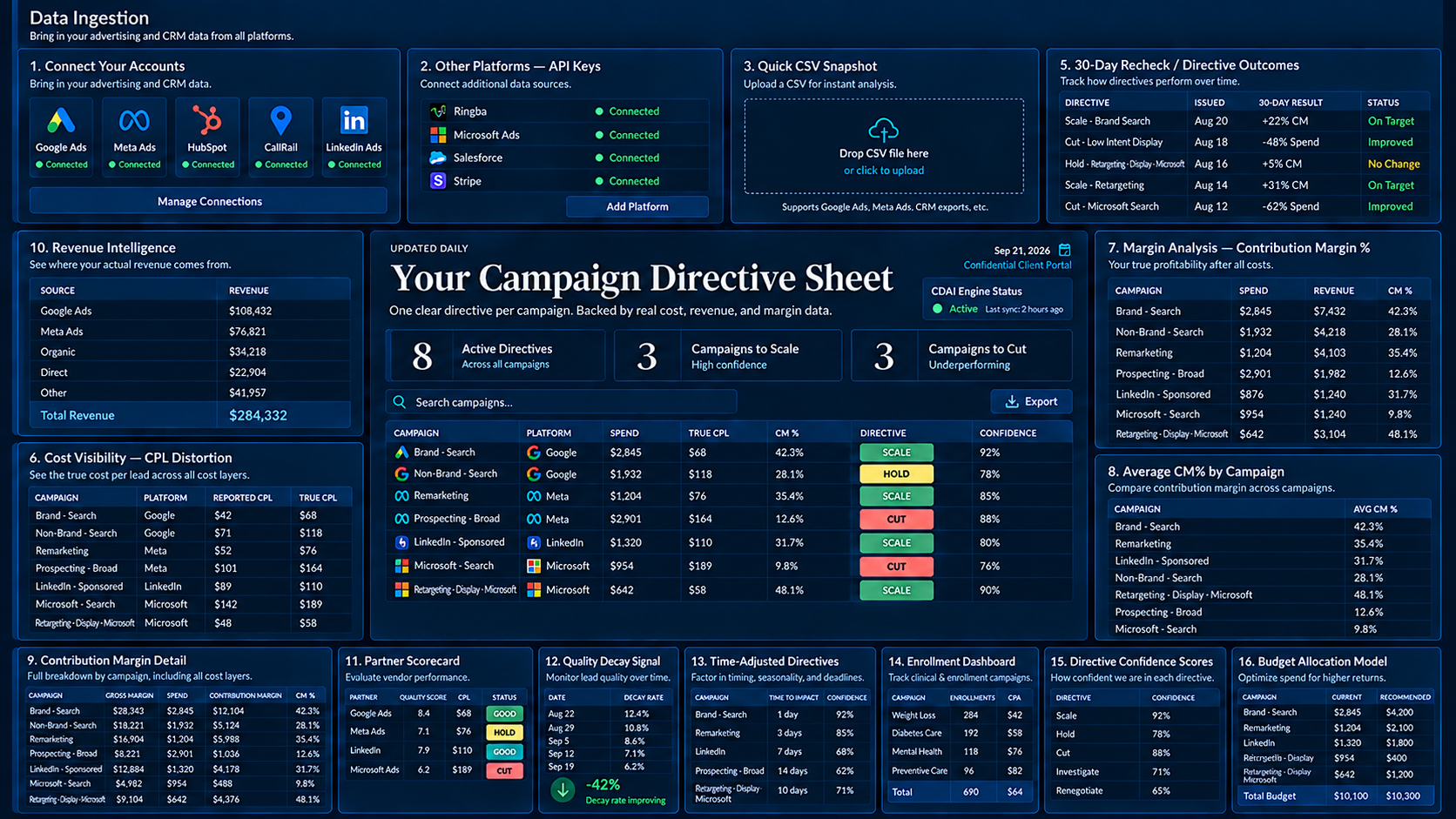
The retest is how CDAI grades itself. CDAI looks at every campaign each night and makes one clear decision for each: scale, hold, cut, pause, quarantine, renegotiate, investigate, or flag. (Our guide to the scale, hold, cut, pause framework explains what each one means.)
Every decision is saved with the numbers it was based on. Once the decision has had time to play out, CDAI measures what happened to that campaign’s profit and marks the call as correct, wrong, or neutral. The grades build into a running scorecard for each business.
“30 days” is the default window. As the next sections show, the window actually matches each business’s sales cycle, because a decision can’t fairly be judged before its deals have had time to close.
Profit here means contribution margin: the revenue a campaign actually kept, minus every real cost of winning it. That includes ad spend, fees, partner payouts, refunds, chargebacks, and compliance costs. If you’re new to the idea, start with how to calculate contribution margin or our explainer on net marketing contribution.
How the Retest Works, Step by Step
- The decision is recorded. CDAI stores the campaign, the decision, its confidence, the reasons, and the campaign’s margin at that moment. That record is the baseline.
- The window plays out. The campaign keeps running and real results arrive: leads, sales, refunds, chargebacks, and partner payouts. Nothing is graded early.
- Before and after are compared. Once the window has passed, CDAI measures the campaign’s margin over the window after the decision and compares it with the same-length window before it.
- The call is graded. The result is judged by that decision type’s own test (next section) and marked correct, wrong, or neutral.
- The grade is stored with its method. Each grade is saved with the version of the grading rules that produced it. If the rules are ever improved, old and new grades are never blended into one number.
This runs automatically every night for every decision whose window has passed. No one picks which decisions get graded. The grade comes from stored numbers and a fixed rule, so the same data always produces the same grade.
What Counts as a Correct Call
A single pass/fail rule wouldn’t be fair, because the decisions are doing different jobs. Here is what each one has to show, in plain terms:
| Decision | What it’s trying to do | Graded correct when |
|---|---|---|
| Scale | Put more money behind a profitable campaign | Margin stays in profitable territory or improves meaningfully |
| Hold | Keep a campaign steady | Margin stays steady. For a campaign with no closed revenue yet, holding is correct unless it turns deeply unprofitable |
| Cut | Reduce spend on a campaign losing money | Margin holds or improves after the cut |
| Pause | Stop a campaign now | Margin recovers, or spend and leads stop as intended |
| Flag | Ask a person to check bad or missing data | The data problem clears up or margin improves. Otherwise the flag is neutral, never counted wrong |
| Quarantine | Keep suspicious leads out of decisions | Fraud falls afterward. This depends on a person acting on the call |
| Renegotiate | Fix a partner taking too much | Margin improves after the partner terms change |
| Investigate | Look into a quality or chargeback problem | Margin improves or steadies afterward |
Two details matter here. First, a hold on a campaign with no closed revenue yet is not graded on “margin stayed flat,” because a margin of zero before any sale isn’t a real starting point. Grading it that way would mark almost every early hold wrong, even when holding was exactly right while deals were still in the pipeline.
Second, the scale test accepts either strong ongoing profit or real improvement. A young campaign can start with an unusually high margin and settle to a still-excellent one as it grows. That’s a win, not a miss.
Why the Window Matches Your Sales Cycle
Thirty days works for many lead-driven businesses. It’s long enough for a budget change to flow through and for early refunds to show up, and short enough that market conditions haven’t shifted much. But it would be wrong for a business whose customers take three months to decide.
So the retest uses a window matched to the typical sales cycle of the business’s industry, the same default CDAI uses when it makes decisions:
| Industry | Window |
|---|---|
| Insurance | 21 days |
| Roofing and home services, solar, and most other businesses | 30 days |
| Mortgage and lending | 45 days |
| Legal and personal injury | 60 days |
| Senior care | 90 days |
| Clinical trial recruitment | 150 days |
Long cycles are exactly where early grading misleads. Personal injury firms, for example, often wait months between a signed case and a settlement; our guide to cost per signed case shows how that lag changes the math.
Judging on the wrong timeline is one of the most common ways marketing measurement goes wrong. A campaign graded before its deals could close looks like a failure when it isn’t. Matching the window to the sales cycle is what keeps the grade fair.
The Results: Validated Before Release
Before release, CDAI’s decisions were checked in a controlled validation across 9 businesses in 7 industries: 89.5% accurate overall (1,210 of 1,352 scored decisions). The underlying math was checked two ways and matched 100%. Here is every decision type, with nothing left out:
| Decision | What it tells you | Accuracy |
|---|---|---|
| Scale | Spend more here | 98.0% (818 of 835) |
| Hold | Keep this steady | 95.2% (40 of 42) |
| Pause | Stop this now | 85.2% (144 of 169) |
| Flag | A person should look at this | 70.9% (200 of 282)The other 82 were neutral; none were wrong. |
| Cut | Reduce spend | 55.6% (5 of 9)All misses came from one deliberately extreme stress-test business. |
| Investigate | Something needs a closer look | 100% (2 of 2) |
| Renegotiate | A partner is taking too much | 100% (1 of 1) |
| Quarantine | Suspicious data, kept out of decisions | Caught correctly in all 12 cases. The outcome depends on a person acting on it, so these 12 count as misses in the overall number. |
We show the weak results next to the strong ones on purpose. A measurement system that only reports its wins isn’t measuring anything. The full method, the businesses, and every result are in the contribution margin marketing validation report.
What the Retest Does Not Do
Good marketing measurement is clear about its limits, so here are ours:
- It isn’t a controlled experiment. The retest compares a campaign with its own recent past. It doesn’t hold back a test group the way incrementality testing does. Funnel’s approach to marketing measurement covers holdout-based incrementality testing, which measures what a campaign caused. The two answer different questions, and many teams use both.
- Outside events still happen. A competitor, a season, or a price change can move results within a window. That’s one reason each decision type has its own test and a flag can end up neutral instead of wrong.
- It doesn’t move your money. CDAI recommends; you decide. Nothing changes in your ad accounts unless a person acts on the call.
- The validation isn’t a guarantee. It shows how the decisions performed across 9 businesses in a controlled setting. Your results will depend on your data, your market, and what you do with each call.
Nielsen’s piece on the success criteria of marketing measurement is a good checklist for judging any tool, including ours.
How to Grade Your Own Marketing Decisions
You don’t need software to start. Here is the same idea as a spreadsheet habit:
- Log every budget decision. Write down the campaign, the date, what you decided (scale, hold, cut, pause), and why.
- Record the margin at that moment. Use real profit, not ROAS: the revenue the campaign kept minus every cost it created.
- Set the window before you look. Match it to how long your customers take to buy, and don’t change it after the fact.
- Compare after with before. When the window ends, measure margin over the same length of time after the decision.
- Grade by decision type. A cut is right if margin held or improved. A scale is right if the campaign stayed clearly profitable or got better. Write the grade down.
- Keep the rules fixed. If you change how you grade, start a new column. Never mix old and new grades into one score.
After a few months you’ll know which kinds of calls your team gets right and which it doesn’t. The hard part is keeping it up. Revenue and refunds arrive late, costs are spread across ad platforms, CRMs, call tracking, and partner invoices, and every campaign needs its own window. That is the work CDAI does every night. If you’re weighing tools, our comparisons of Triple Whale, Rockerbox, and Allocera and our Northbeam alternative guide show where attribution tools stop and profit-based decisions begin.
How CDAI Runs the Retest Every Night
CDAI connects to the CRM and ad accounts you already use, and every night, for every campaign, it:
- Calculates real profit: true cost per lead, true customer acquisition cost, and margin after every cost.
- Makes one clear decision, with the numbers and a confidence level behind it. You stay in control of every move.
- Rechecks its own math. Recent scale, hold, and cut decisions are recalculated from the raw data, and any mismatch raises an alert.
- Grades past decisions once their window has passed, with the dollar impact, so you can see how its calls have actually worked out for your business.
- Stops on bad data. Serious data problems stop that night’s decisions instead of driving them.
See the full loop on how it works, or browse more guides on marketing ROI measured as profit.
Marketing Measurement FAQs
What is marketing measurement?
Marketing measurement is the practice of connecting marketing spend to business results like revenue, profit, and new customers. The common methods are attribution, marketing mix modeling, and incrementality testing. The retest adds a step most tools skip: grading each decision against the profit that followed.
Why is it called the 30-day retest if some windows are longer?
Thirty days is the default window, and it fits many lead-driven businesses. The window actually matches each business’s sales cycle, from 21 days for insurance to 150 days for clinical trial recruitment, so no decision is judged before its deals could close.
What does a neutral grade mean?
Neutral means the result neither confirmed nor contradicted the call. It mostly happens with flags: if a data problem hasn’t cleared up but nothing went wrong either, the flag isn’t counted as wrong. In the validation, 82 flags were neutral and none were wrong.
Does CDAI change my ad campaigns?
No. CDAI recommends and you decide. Every decision is advice with the numbers behind it. Nothing changes in your ad accounts unless a person on your team acts on it.
Is 89.5% a guarantee of future accuracy?
No. It’s the result of a controlled validation across 9 businesses in 7 industries, before release. It shows how the decision rules performed on that data. Your own scorecard builds up as CDAI grades its decisions for your business.
How is the retest different from incrementality testing?
Incrementality testing holds back a group of people from seeing a campaign to measure what the campaign caused. The retest compares a campaign with its own recent past to grade whether a budget decision paid off. One measures a campaign’s effect; the other measures the quality of the decision.
See How Your Marketing Decisions Really Perform
Connect the CRM and ad accounts you already use. CDAI calculates real profit for every campaign, makes one clear decision each night, and grades its own calls.